Dunboyne College of Further Education
Introduction and Learner Profile
Dunboyne College of Further Education is located in an industrial estate just outside Dunboyne Village. Dunboyne College’s mission is to give their learners the knowledge and skills to achieve their professional goals. They offer a wide variety of courses at levels 5 and 6. Examples include Computer Networks and Systems, Culinary Skills, Childcare, Beauty and Social Studies. It has a diverse student population mainly drawn from secondary schools in the area but also a large number of older students returning to education. There is a large teaching staff at the college which includes several support staff. These staff work from an area called the learning hub where students with additional needs can be helped with coursework and given tools to help them be successful. The classrooms in Dunboyne College are all equipped with a computer for the teacher and a projector. There are 3 computer rooms that students have access to when they are not being used for classes as well as a well-stocked library.
Reflection
I thoroughly enjoyed my time in Dunboyne College. Overall it was a great place to spend time. I had a fantastic cooperating teacher who was incredibly helpful and gave me the space to learn and grow as a teacher. The staff were friendly and worked in a very collaborative manner. Despite this, teaching in Dunboyne College was challenging.
I spent the first few weeks in Dunboyne just observing. I sat in on classes run by my cooperating teacher and other teachers in the college. I saw a wide variety of teaching styles in action. This helped me considerably in forming my own ideologies on teaching. It also gave me a great confidence boost, I saw teachers who taught in their individual styles unapologetically. It meant that when I went in to teach alone in Dunboyne for the first time, I wasn’t afraid to deviate from the style of my cooperating teacher. His style is very different from mine. It relies very heavily on PowerPoint presentations without any other activity in the class. It means that learners are often unengaged and distracted by their phones, particularly by snapchat. Observing for a significant amount of time also allowed me to build good relationships with the learners, something I would discover to be a particularly important facet of my own teaching philosophy.
All the staff in Dunboyne embraced having a student teacher in the building. Bob the maintenance man greeted everyone with a smile and a hello. He knows everyone’s name and asks them about their lives. He is the sort of person I want to be. The kind of person who is just nice to everyone, who cares about everyone and their lives. It has become an important facet of my teaching, to care. It was always there I think. Most of my background is from community education settings and care is a very important thing to have there. You need to care about your learners on some level, be invested in them and their lives in order to help them to achieve their goals. There are many things that can be blocking our learners from being successful and they are more likely to talk about them if they feel that you care. This is one of the biggest lessons I take away from Dunboyne. That care doesn’t have to be anything big. A simple hello, knowing someone’s name and caring about their lives is enough.
In the Youthreach I learnt that I need structure and a collaborative and supportive environment in order to thrive. The class schedule for Dunboyne was designed weeks before the term started. On the day I arrived, I was handed a timetable which was marked with where I needed to be for the hours I was there. I was introduced to the two people who I would be with the most. Between them they taught the majority of the modules for computer systems and networks. I knew what was expected of me in those first few weeks. I was also told just to say when I was ready to start teaching and they’d accommodate that. I was permitted to pick whichever topics I wanted to teach from the modules. I was offered resources and an experienced eye to look over my work before bringing it into the classroom. I walked in to the first class I planned and taught alone fully confident that my cooperating teacher had my back and if anything went wrong they would step in. When I was left alone after those first classes, it was with the reassurance that they were only a text away if I needed them. Thankfully I never did, but knowing it was there was comforting while I was still finding my feet. The teachers in Dunboyne were very generous with advice and tips. They checked how I was doing regularly, answered any questions gladly and treated me very much as one of them. It meant a lot and it’s the sort of environment I’d like to work in.
Teaching students who were straight from the Leaving cert was a new experience for me. They were very used to just being given information and asked to give it back. This became clear very quickly and indeed was the most common form of teaching style I observed through all of my placements. There was an overuse of PowerPoint and lecturing rather than a mixture of methodologies. When I was thinking about how to teach this group in Dunboyne, I spent a long time trying to find different ways of teaching the material, rather than just giving it to them. Programming posed a particular problem. It is very specific and has a lot of rules. At its heart, programming is about problem solving. So instead of presenting a piece of code and saying this does x, I gave them the tools. I showed them what the elements they would need were at the beginning of the class, ensured they understood them and then presented them with a problem. For example, one day I asked them to make a calculator that would add and subtract. After giving them the elements needed, I allowed them a lot of time (often the rest of the class) to try and solve the problem posed. I found this to be a very good way of teaching programming. It meant that learners had a good foundation in the theory, from the beginning part of the class, but also had a lot of time to get to the heart of it, which is problem solving. This also allowed for similar methodology to be used in other subjects, which you will see from the class I taught for my third placement visit. Technology also became a cornerstone of my teaching practice in Dunboyne. The learners were all around 17 years old. They enjoyed using their phones and had a habit of doing so in class. So, I decided to use them. We used apps like Mentimeter, Socrative and Kahoot to make classes a little more interesting and exciting. Learners responded well to this and it created some of the most enjoyable learning experiences for them in the class. I think technology is a great thing and incorporating it into classrooms, particularly with younger learners, brings good energy and excitement to the class.
The biggest challenge and learning curve of teaching in Dunboyne was trying to get the learners to work well in groups. Group work was not something they were used to doing. Unfortunately, they had very little choice because a number of their assignments required them to work in ‘teams or pairs’. It is also important because the courses that most of them applied to value teamwork and collaboration. They need these skills in order to be successful at the next step in their education. As discussed earlier, my cooperating teacher’s style of teaching left no room for activities and definitely none for group work. I had only ever been in the position of starting out with a new group before so walking into this already established group was hard. They had been together for about 4 weeks when I arrived and had gotten used to the style of teaching that was already there. I went in knowing all this. For the first class I had them, I decided to break them into pairs to play an online game as part of a class on the history of computing. It didn’t go well. Some learners refused to talk to the person they had been paired with, some point blank refused to get into their pairs and one pair ended up having a bit of a argument. I went back to the drawing board. Obviously, they weren’t ready yet for actual work in teams. I started out small, asking them to turn to the person beside them and have a chat about a topic. Moved on from there to asking them to do a small task with the person beside them and so on until it got to a point where they could effectively work with one other person. Then I began to put them into larger groups for fun activities like quizzes instead of always making it about a task that needed to be done. By the time the assignments that needed to be done in groups came around, they were able to effectively complete it with no falling out and no hassle. There are a few things I learnt from this. First, don’t walk in and try and change something that learners are used to. Change needs to be slow and gradual and you need to make sure they are happy and comfortable at every step along the way. Second, working in groups is a skill. If people aren’t used to it, it won’t go well. It needed to be a baby stop process for this particular group. They were used, from school, to being judged on their own individual work only. I hope now that the majority of them are off to college courses, that their teamwork skill will serve them well.
Dunboyne College was a fantastic, supportive and inclusive place to do teaching practice. I was giving a lot of freedom but also all the necessary support and resources to be successful. Looking back I learnt a lot about the kind of environment I’d like to be in in the future. I felt safe and secure there and knew that there was not one member of the staff who would be put out if I asked for help with something. This is in direct contrast to the placement in Youthreach. I was forced to come up with new and creative ways of teaching materials in order to maintain the learners’ interest. This skill has served me well since and is one I brought to my third placement and every subsequent place I have taught. I had one big challenge in Dunboyne, that the learners did not work well in groups. I made it my mission to change that and so I made small steps to get them to a point where they could successfully complete an assignment as a group.
Hours Verification Form - DB.jpg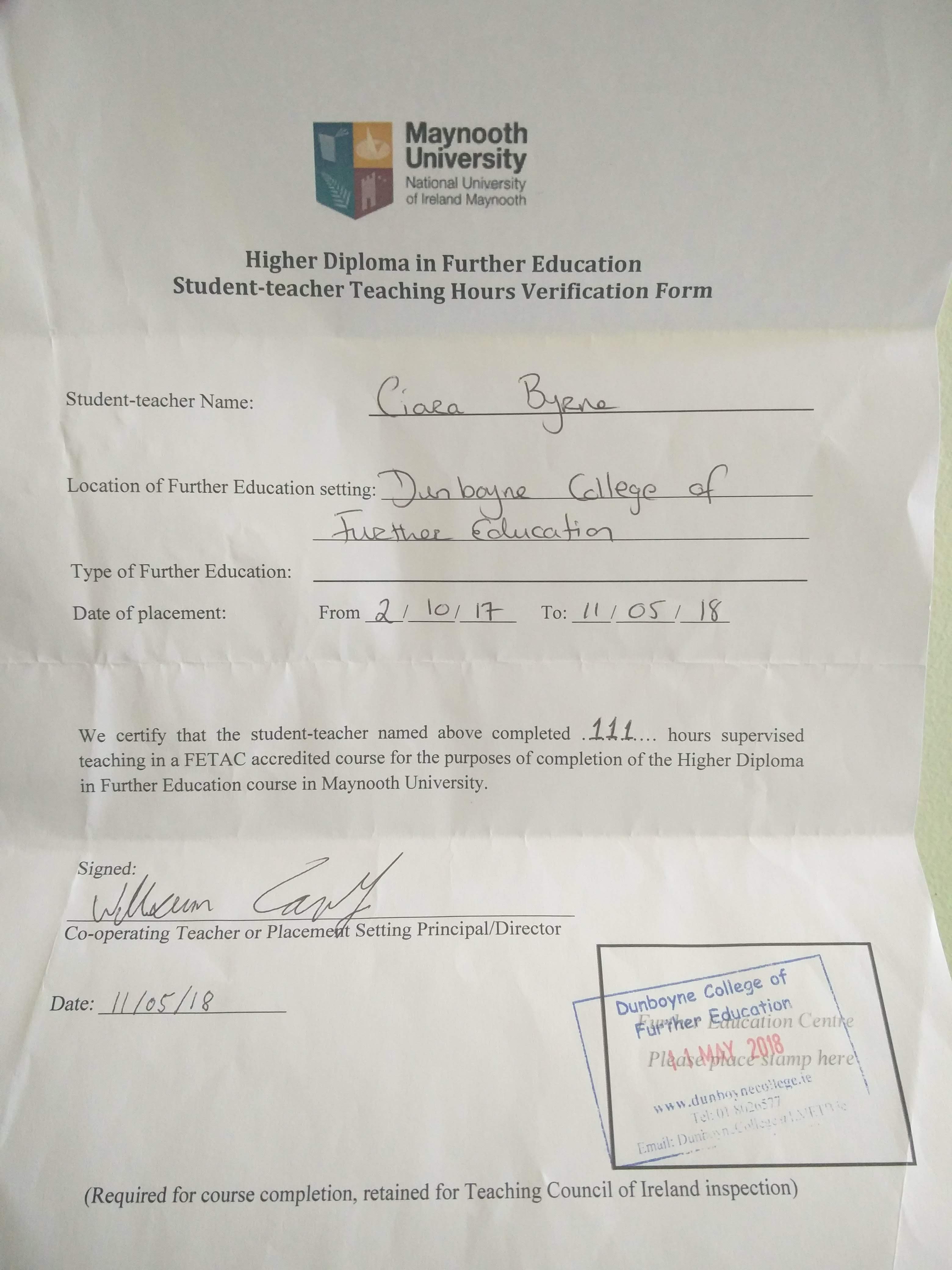
Intro to Photoshop
The aim of this class was to give learners some grounding in Photoshop. It was an hour-long class and therefore I could not fit a lot into it. At the beginning of the class I gave a short presentation about the importance of only using images which are available for reuse by their original owner. One of the best places to find these images is Creative Commons and so that is where I directed them. I gave a short demonstration of some of the basic tools of Photoshop. For the rest of the class, I gave the learners the space to explore Photoshop. I spent the time walking around helping anyone that needed it. The learners enjoyed the chance to get creative and some of the work produced was pretty impressive.
Introduction to Photoshop.pptxstudent-work-1.png

student-work-2.png

student-work-3.png

student-work-4.png

Supervision Visit 1
When planning for this class I started out knowing that I would need to have a lot of variety in the classes for the learners. They lose focus relatively quick so I made sure that the plan incorporated as many different activities without trying to fit too much into the time. The learners enjoy participatory tasks. I chose to begin with an explanation using the whiteboard and drawing pictures. I began the class by discussing numbers as we know them currently. I asked them for ways of writing numbers. We started with the number 23, which the learners said could be written as 23, twenty three, XXIII in Roman numerals, in different languages and using maths equations such as 20+3. Eventually someone suggested writing it as 1s and 0s, which is what binary is. We then discussed that the traditional (or decimal) number system has a base of 10. We then moved on to discussing other number systems, such as binary, which is a base 2 number system. I drew out all of these aspects on the whiteboard while
I was talking to explain them to the learners. I demonstrated how to convert between decimal and binary and then we, as a class did a number of conversions together.
The next task was to ask for a number of volunteers to be binary numbers. I had 5 volunteers who represented a binary number. They were sitting down to begin with which means they were representing 0 or ‘off’. I threw out random numbers to the class and had them arrange their classmates into different numbers. This took up a lot of time and got quite loud, but the learners enjoyed it and it seemed to be successful in getting them to understand how to ‘construct’ a binary number. After this, we took a break.Following the break, we moved on to a presentation which explained some of the background behind the information which had already been presented as well as a short video joke about binary numbers. I then opened the class up to discussion to ensure everyone was following along and to answer any outstanding questions.
The final activity of the class was a quiz in small groups. Learners were divided up into teams and asked to convert numbers from denary to binary, and the last question asks them to convert a sequence of binary numbers back again. Instead of just shouting out numbers or displaying them on the board, I decided to play a short clip from a song that contains a number. Each clip was played, the learners heard the number and then converted it to binary. Only one piece of music didn’t work and so Josephine was kind enough to sing it for them. We finished up with a quick recap and a check in to make sure everyone was ok.
Teaching Practice Report -1.docComputer Systems and Hardware_Class Plan 04_12_17.docx
Group Decode Exercise.docx
Number Cards.docx
Binary Numbers.pptx
Binary Numbers Quiz.pptx
Supervision Visit 3
This visit fell in the last week of classes at Dunboyne College. I discussed what I should do for the visit with my cooperating teacher. He put forward that exam revision was the most logical topic considering most things had already been covered and learners were working on assignments during class time for the most part. This meant I was tasked with making revision interesting. I came up with some very elaborate ideas to begin with, such as a human board game and a giant scavenger hunt. However, I realised that these would be a logistical nightmare and I wondered if learners would actually gain anything from it besides having a good time. I decided that the best thing to do would be to spent the 2 hour class in the morning answering the long questions for the two exams I was preparing them for, Mobile Technologies (5N0580) and Programming Principles and Design (5N2927). We first did a check in using Mentimeter asking them to place themselves on a scale for how prepared they felt about each of the exams. The majority placed themselves at the lower end and in the middle.
For the main activity, I took pieces of coloured card and wrote one question on each one. I then folded them over and had pairs of learners pull them out of a hat. Some were easier than others and this seemed to be the fairest way of distributing them. In their pairs I allowed them as much time as they needed to answer the question in front of them effectively. I did not give answers but did give plenty of encouragement and any help that was needed. When each pair finished a question, they were given another and then another. In doing this, the class generated the notes for the exams together rather than me making them notes and telling them to learn them. It also helped them to think critically, which would be essential, particularly for the programming exam. We did take a short break around the 1 hour mark.
Towards the end of the class, we spent some time going through the answers they had given and the rest of the class was asked whether they were correct or not. I had planned to step in if there was anything completely wrong, but luckily there was not. This brought us up to lunchtime and the time for Michael to leave. The class continued into the afternoon, using the time to practice short questions using Socrative. Lesson Plan.docxMobile Technologies - Sample Questions.docx
Programming Principles and Design- Sample Questions.docx
Quiz_programmingprinciplesanddesign.pdf
Mobile Technologies - Sample Answers (Learner Generated).docx
Programming Principles and Design- Sample Answers (Learner Generated).docx
TP3 - Ciara Byrne - 27 April 2018 - Michael Kenny.doc
DALC keyboard_arrow_right